
Lithium vs Tubular Battery for Solar in Pakistan is mainly a choice between lower upfront cost and better long-term performance. Tubular batteries are cheaper to buy and remain useful for budget-conscious backup systems, while LiFePO4 lithium batteries offer more usable capacity, deeper cycling, faster charging, lower maintenance and generally much longer cycle life.
For a home that uses its battery almost every day, lithium is usually the stronger long-term option. For occasional load-shedding backup where the initial budget is the main concern, a good-quality tubular battery can still make sense.
This comparison explains the real differences in price, backup capacity, lifespan, maintenance, charging, heat, inverter compatibility and total ownership cost so you can choose the right battery for your solar system in Pakistan.
Table of Contents
- Quick Verdict: Lithium or Tubular?
- What Is the Difference Between Lithium and Tubular Batteries?
- Lithium vs Tubular Battery Comparison
- Lithium vs Tubular Battery Price in Pakistan
- Usable Capacity and Depth of Discharge
- Which Gives More Backup?
- Battery Lifespan and Cycle Life
- Charging Speed and Solar Performance
- Maintenance Requirements
- Performance in Pakistan’s Heat
- Inverter Compatibility
- Which Battery Is Cheaper in the Long Run?
- Which Battery Should You Choose?
- Battery Buying Checklist
- Common Buying Mistakes
- Frequently Asked Questions
- Final Verdict
Quick Verdict: Lithium or Tubular?
Short answer: For daily solar cycling and long-term use, LiFePO4 lithium is generally the better choice. It provides more usable energy from the same nominal capacity, needs little routine maintenance and is designed for substantially more cycling. Tubular batteries are better when upfront budget is the main constraint or backup is used only occasionally.
| Situation | Better Choice | Why |
|---|---|---|
| Lowest upfront cost | Tubular | Usually much cheaper to purchase |
| Daily battery cycling | Lithium | Better suited to frequent deep cycling |
| Occasional load shedding | Tubular | Lower initial investment can be attractive |
| Long-term solar storage | Lithium | Longer cycle life and higher usable capacity |
| Low maintenance | Lithium | No routine distilled-water topping-up for typical sealed LiFePO4 packs |
| Limited installation space | Lithium | Higher energy density and compact designs |
| Very tight budget | Tubular | Lower purchase price |
If you want to estimate actual backup rather than comparing battery labels, use the Battery Backup Time Calculator after deciding which technology you prefer.
What Is the Difference Between Lithium and Tubular Batteries?
A tubular battery is a type of lead-acid battery that uses tubular positive plates. It has been widely used in Pakistan for UPS and solar backup because it is comparatively affordable and readily available.
A lithium solar battery is normally a lithium-ion battery, with LiFePO4 being a common chemistry for stationary solar storage. A modern LiFePO4 pack usually includes a Battery Management System, or BMS, to monitor and protect the cells.
The biggest difference is not simply “lithium lasts longer.” The important differences are how deeply the battery can be used, how frequently it can be cycled, how efficiently it stores and releases energy, how much maintenance it needs and how much usable energy you receive from its rated capacity.
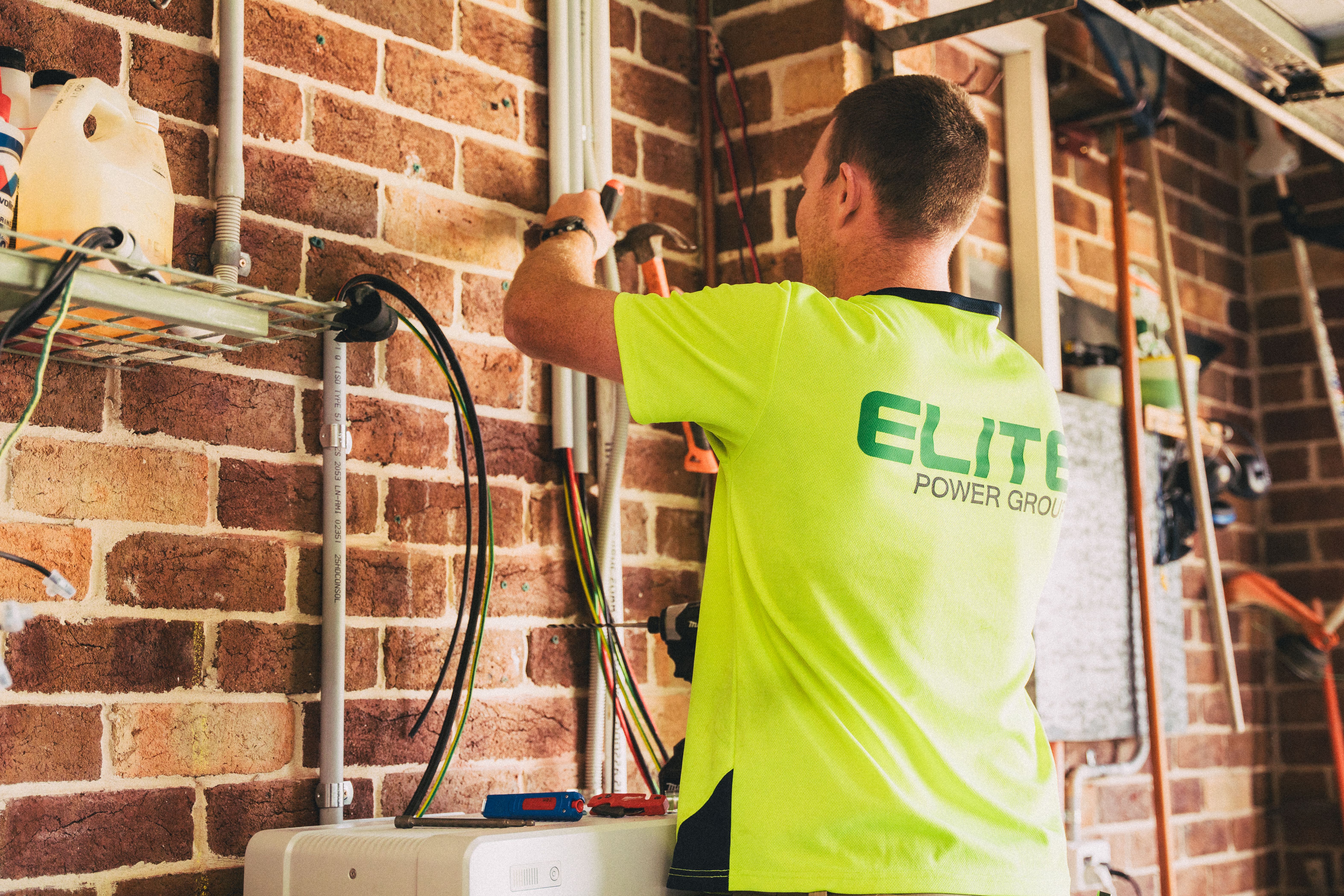
Solar battery installation involves more than selecting the battery itself; inverter compatibility, wiring, protection and correct charging settings also matter.
Lithium vs Tubular Battery Comparison
| Feature | LiFePO4 Lithium | Tubular Lead-Acid |
|---|---|---|
| Upfront cost | Higher | Lower |
| Usable depth of discharge | Usually much deeper | Usually more conservative |
| Cycle life | Generally much higher | Generally lower |
| Routine maintenance | Very low | May require water and terminal maintenance depending on design |
| Charging | Generally faster | Generally slower |
| Weight | Lower for equivalent usable storage | Higher |
| Space requirement | Lower | Higher |
| Battery monitoring | Usually BMS-based | Primarily voltage, current and battery condition monitoring |
| Daily cycling | Excellent fit | Possible, but cycling depth affects life significantly |
| Best for | Frequent solar storage and long-term backup | Budget-conscious backup and occasional use |
The exact figures vary considerably by manufacturer, model, temperature, charging profile and depth of discharge. Therefore, a generic “lithium lasts exactly X years” or “tubular lasts exactly Y years” claim should not be treated as a guarantee.
Lithium vs Tubular Battery Price in Pakistan
Short answer: Tubular batteries normally have the lower purchase price, while lithium batteries cost considerably more for a comparable nominal storage size. Current Pakistani listings show substantial variation between brands and capacities, so comparing the price of one battery against another without comparing usable kWh can be misleading.
For example, current market listings show 200Ah-class tubular batteries at substantially lower prices than 5kWh-class lithium batteries. Retail prices vary by brand, capacity, warranty, city, dealer and stock condition.
| Battery Type | Typical Market Position | Main Cost Advantage | Main Limitation |
|---|---|---|---|
| Tubular lead-acid | Lower-cost storage | Lower initial purchase price | Lower usable capacity and shorter cycling life |
| LiFePO4 lithium | Premium storage | More usable energy and longer cycling life | Higher upfront price |
Solar Pakistan Guide’s existing solar battery price guide contains Pakistan-specific market ranges and individual brand/model examples. Because battery prices move with exchange rates, imports and dealer stock, use current quotations rather than treating an old price as permanent.
As one current market reference, Pakistani retailers list 5.12kWh lithium batteries from brands such as Dyness, BYD and Pylontech at different price points, while tubular products occupy a much lower upfront-cost segment. These listings demonstrate why capacity, chemistry and brand must be considered together rather than using one “average battery price.”
Usable Capacity and Depth of Discharge
One of the biggest mistakes buyers make is comparing batteries only by Ah rating.
A battery’s nominal energy can be estimated as:
Battery energy (Wh) = Voltage × Ah
For example, a 12V 200Ah battery has approximately 2,400Wh, or 2.4kWh, of nominal energy.
But nominal capacity is not the same as the energy you should routinely use. Depth of Discharge (DoD) describes how much of the stored capacity is discharged.
For planning purposes, a tubular lead-acid battery is often operated around a conservative 50% DoD, although the correct limit depends on the manufacturer and application. LiFePO4 systems can generally be designed for substantially deeper discharge, subject to the manufacturer’s specified operating limits.
| Example | Nominal Energy | Illustrative Usable Energy |
|---|---|---|
| 12V 200Ah tubular | 2.4kWh | About 1.2kWh at 50% DoD |
| 51.2V 100Ah lithium | 5.12kWh | About 4.1–4.6kWh at 80–90% DoD |
The lithium example above is an illustration, not a universal specification. Always use the battery manufacturer’s permitted DoD when calculating a real installation.
This is why comparing a “200Ah tubular” with a “100Ah lithium” by Ah alone can produce the wrong conclusion. Voltage and usable kWh matter.
Which Gives More Backup?
Short answer: A lithium battery can provide more usable backup from a compact battery bank because a greater portion of its rated energy can normally be used. However, actual backup depends on battery capacity, DoD, inverter efficiency, appliance load, battery temperature and battery condition.
For example, two 12V 100Ah batteries connected in series create a 24V 100Ah bank with 2.4kWh nominal energy. At a 50% DoD and after allowing for an inverter’s losses, the usable AC energy is considerably below 2.4kWh.
The same principle applies to lithium: a 5.12kWh battery does not deliver 5.12kWh of usable AC energy to appliances because discharge limits and conversion losses must be considered.
For an actual installation, first calculate the loads you want to operate during an outage, then size the battery around the required backup duration.
You can use the Battery Backup Time Calculator to estimate runtime for a specific battery and appliance load.
Battery Lifespan and Cycle Life
Short answer: Lithium batteries generally have a much higher cycle-life potential than conventional lead-acid batteries when both are used for repeated solar cycling. However, the actual life of either technology depends on DoD, temperature, charging settings, discharge rate, maintenance and battery quality.
Cycle life means the number of charge/discharge cycles a battery can complete before its capacity falls to a specified level. It is not the same thing as calendar life.
Technical energy-storage literature consistently shows that lead-acid batteries have shorter cycle-life characteristics than lithium-ion systems under comparable repeated-cycling conditions. One NREL/USAID technical reference, for example, lists representative cycle-life ranges of roughly 500–1,000 cycles for lead-acid and around 3,000 cycles at 80% DoD for lithium-ion, while emphasizing that battery performance varies by technology and operating conditions.
That does not mean every lithium battery will reach 3,000 cycles or every tubular battery will stop working at 1,000 cycles. Manufacturer warranty conditions and test methods must be checked for the exact model.
Why Daily Cycling Changes the Calculation
If a battery is cycled almost every day, cycle life becomes especially important.
A battery rated for a relatively small number of cycles may need replacement much sooner than a battery designed for thousands of cycles. Therefore, the cheapest battery at the time of purchase may not be the cheapest battery over a long ownership period.
This is particularly relevant for households using solar during the day and battery storage every evening.
Charging Speed and Solar Performance
Lithium batteries generally accept charging more efficiently and can support faster charging than many lead-acid systems, provided the battery, inverter and charging equipment are correctly matched.
That matters in Pakistan because a battery may have only a limited window during the day in which solar energy is available for charging.
A battery that can accept the available solar charging power efficiently can be useful when the system needs to recharge between outages.
Lead-acid batteries also need correct charging stages and voltage settings. Repeated undercharging, overcharging or excessive discharge can shorten their useful life.
Never assume that an inverter’s default lithium or lead-acid setting is correct for every battery. Use the battery manufacturer’s charging-voltage, current and communication requirements.
Maintenance Requirements
Tubular batteries can require more maintenance than typical sealed lithium systems. Depending on the battery design, lead-acid maintenance can include checking electrolyte levels, adding distilled water and inspecting terminals and connections.
Older or poorly maintained lead-acid batteries can also develop reduced capacity and increased internal resistance.
LiFePO4 batteries normally use a BMS to monitor cell conditions and protect against situations such as overcharge and over-discharge. That does not mean lithium batteries are maintenance-free in the broader sense. Connections, ventilation, temperature and inverter settings still need to be checked.
For either technology, installation quality is important. A good battery installed incorrectly can perform worse than a cheaper battery installed correctly.
Performance in Pakistan’s Heat
Pakistan’s climate makes battery temperature an important consideration.
High temperatures can accelerate battery degradation, particularly in lead-acid systems. Battery manufacturers specify operating and charging temperature limits for a reason.
A battery room should therefore not be treated as an afterthought. Avoid placing batteries in an unnecessarily hot, poorly ventilated area, and follow the manufacturer’s installation instructions.
For flooded or vented lead-acid batteries, ventilation is especially important because charging can produce gases. Keep the installation area safe, dry and appropriately ventilated.
For lithium batteries, do not assume that the word “lithium” means unlimited heat tolerance. The specific battery has its own temperature limits and protection system.
Inverter Compatibility
This is one of the most important checks before buying a lithium battery.
A lithium battery may have the correct voltage and still not be the ideal match for a particular hybrid inverter. Some systems use CAN or RS485 communication between the battery BMS and inverter so that the inverter can receive information such as state of charge, charge limits and protection status.
Before purchasing, confirm:
- Battery nominal voltage
- Inverter battery-voltage range
- Maximum charging current
- Maximum continuous discharge current
- Maximum PV charging power supported by the inverter
- CAN or RS485 communication requirements
- Compatible battery protocol
- Battery firmware requirements, if applicable
- Warranty conditions
- Authorized installation requirements
For tubular batteries, confirm the inverter’s lead-acid charging profile and the manufacturer’s recommended voltage settings.
Do not buy a lithium battery simply because its voltage says 48V or 51.2V. Compatibility is a system-level question.
Which Battery Is Cheaper in the Long Run?
Short answer: Tubular batteries are usually cheaper at the checkout counter, but lithium can be cheaper over a long ownership period when the battery is cycled frequently. The correct comparison is total cost divided by usable energy delivered over the battery’s useful life, not simply the purchase price.
Consider a simplified example.
| Factor | Tubular | LiFePO4 Lithium |
|---|---|---|
| Initial purchase | Lower | Higher |
| Usable fraction of capacity | Generally lower | Generally higher |
| Daily cycling suitability | Moderate | High |
| Replacement frequency under heavy cycling | Usually higher | Usually lower |
| Routine maintenance | Higher | Lower |
| Long-term value | Depends strongly on usage | Often stronger for daily cycling |
A proper comparison should calculate:
Lifetime cost per usable kWh = Total battery ownership cost ÷ Total usable kWh delivered during its useful life
This calculation should include the purchase price, expected usable capacity, cycle life, efficiency, maintenance and replacement cost.
For a battery used only occasionally, the cheaper tubular option can remain financially sensible because its higher cycle-life potential may never be used.
For a household cycling the battery every day, the calculation can shift strongly toward lithium.
Which Battery Should You Choose?
Choose Lithium If You:
- Use your battery almost every day.
- Want long-term solar storage.
- Need more usable energy from limited space.
- Want low routine maintenance.
- Expect frequent load shedding.
- Want faster recharge capability.
- Plan to keep your solar system for many years.
- Can afford the higher upfront cost.
Choose Tubular If You:
- Have a strict initial budget.
- Use battery backup only occasionally.
- Already have a compatible lead-acid inverter setup.
- Have adequate space for the battery bank.
- Are comfortable with the maintenance requirements.
- Need a lower-cost backup solution rather than maximum long-term efficiency.
What About a 5kW Solar System?
A 5kW solar system does not automatically require one specific battery type. The correct battery depends on the loads you want to run after sunset, the expected backup hours and whether the system is hybrid or off-grid.
For example, a household that only wants to keep fans, lights, Wi-Fi and a refrigerator running during short outages may need much less storage than a household trying to operate an air conditioner overnight.
Start with your actual load rather than choosing the battery based only on the solar system’s kW rating.
For a more complete system-sizing process, see the Solar Load Calculator and then calculate the expected runtime using the Battery Backup Time Calculator.
Battery Buying Checklist for Pakistan
Before paying a dealer, check the following points.
- Confirm the exact model number. Do not rely only on the brand name.
- Check nominal voltage and capacity. Compare kWh, not only Ah.
- Ask for the datasheet. Verify DoD, charge current and discharge current.
- Check cycle-life conditions. Ask at what DoD and temperature the stated cycle figure applies.
- Verify warranty terms. Check both years and any throughput or cycle limitations.
- Confirm inverter compatibility. This is particularly important for lithium batteries.
- Check manufacturing date. This is especially important when purchasing stored lead-acid batteries.
- Confirm whether installation is included.
- Get the invoice and warranty card.
- Use an authorized dealer where possible.
Do not choose a battery solely because a dealer says it has “5,000 cycles” or “10 years life.” Ask what testing conditions and DoD the number represents.
Common Buying Mistakes
1. Comparing Ah Instead of Usable kWh
A 200Ah 12V battery and a 100Ah 51.2V battery are not equivalent storage products. Voltage must be included in the calculation.
2. Comparing Purchase Price Only
A lower purchase price does not automatically mean lower ownership cost. Replacement frequency and usable energy matter.
3. Ignoring Depth of Discharge
A battery’s advertised capacity is not necessarily the capacity you should repeatedly use. Always check the manufacturer’s recommended DoD.
4. Ignoring Heat
Battery temperature affects performance and longevity. A poorly ventilated, extremely hot battery location can reduce expected life.
5. Buying Lithium Without Checking Communication
Voltage compatibility alone does not guarantee that a lithium battery will communicate correctly with a hybrid inverter.
6. Oversizing the Battery Without Understanding the Load
A large battery is not automatically better. If your normal backup load is small, unnecessary storage increases the system cost without providing proportional value.
7. Using Old Regulatory Information
Pakistan’s solar prosumer and grid-export framework changed during 2026. If your battery decision is connected to a new solar installation or grid-export arrangement, verify the current NEPRA and DISCO requirements before finalizing system design.
For documentation requirements, see the Net Metering Documents Required in Pakistan guide.
Frequently Asked Questions
Is lithium better than tubular battery for solar in Pakistan?
For frequent daily cycling, lithium LiFePO4 is generally the better long-term choice because it offers deeper usable capacity, longer cycle life, low routine maintenance and compact storage. Tubular batteries remain useful when the initial budget is the main concern or battery use is occasional.
Which battery is cheaper, lithium or tubular?
Tubular batteries are normally cheaper to purchase upfront. Lithium batteries cost more initially, but their higher usable capacity and longer cycle life can make them more economical over a long period when they are cycled frequently.
How long does a lithium battery last compared with a tubular battery?
There is no single guaranteed lifespan for either type. Lithium batteries generally have a much higher cycle-life potential than lead-acid batteries, while actual life depends on DoD, temperature, charging, discharge rate and battery quality. Always compare the manufacturer’s warranty and cycle-life conditions.
Is LiFePO4 better than tubular for load shedding?
For frequent load shedding, LiFePO4 is usually the stronger option because it can tolerate deeper cycling and normally requires less routine maintenance. Tubular can still be practical for occasional outages where lower upfront cost matters more.
Can I replace tubular batteries with lithium?
Sometimes, but not automatically. The inverter must support the lithium battery’s voltage, charging requirements and, where required, BMS communication. Check compatibility with both the inverter and battery manufacturer before replacing the bank.
Is a 200Ah tubular battery equal to a 200Ah lithium battery?
No. Ah alone does not determine stored energy. Voltage, usable depth of discharge and efficiency must also be considered. A 12V 200Ah battery stores about 2.4kWh nominally, while a 51.2V 200Ah lithium battery stores about 10.24kWh nominally.
Which battery is best for a 5kW solar system in Pakistan?
There is no universal answer. If the 5kW system is used with frequent battery cycling and long-term backup is important, LiFePO4 is generally the stronger choice. If the system is primarily for occasional backup and the budget is limited, tubular may be appropriate.
Does lithium battery need maintenance?
Typical LiFePO4 batteries require much less routine maintenance than flooded tubular batteries. However, the installation still needs correct wiring, protection, temperature management and inverter settings, and the manufacturer’s maintenance instructions should always be followed.
Can tubular batteries work with solar panels?
Yes. Tubular batteries are widely used with compatible solar and hybrid inverter systems. The inverter must use an appropriate lead-acid charging profile and the battery should be operated according to its manufacturer’s voltage, current and DoD recommendations.
Is lithium worth the extra money?
It can be, especially if the battery is cycled frequently. The higher initial cost buys greater usable capacity, longer cycle-life potential and lower routine maintenance. For occasional backup, the financial advantage may be smaller, making tubular a reasonable budget choice.
Final Verdict: Lithium vs Tubular Battery for Solar in Pakistan
If your priority is the lowest upfront cost, tubular remains the easier choice.
If your priority is daily solar cycling, long-term ownership, usable capacity, low maintenance and compact storage, LiFePO4 lithium is generally the better choice.
The most important lesson is not to compare batteries by price or Ah alone. Compare usable kWh, DoD, cycle life, charging capability, warranty, inverter compatibility and total ownership cost.
For most homeowners planning a modern hybrid solar system that will use the battery frequently for many years, lithium deserves serious consideration even though the initial quotation is higher. For occasional backup and a limited budget, a properly selected tubular battery can still provide practical value.
Before buying, calculate your actual load and required backup time rather than allowing the battery brand or headline capacity to determine the system size.
Bottom line: Tubular wins on upfront affordability; lithium generally wins on long-term performance and frequent cycling.
Research note: Battery performance figures are technology-level planning ranges rather than guarantees for every model. Always use the manufacturer’s current datasheet, warranty and installation instructions for final system design.

Waseem Abbas is the Founder and Solar Research Editor at Solar Pakistan Guide, where he researches Pakistan’s solar energy market and publishes practical guides on solar panels, inverters, batteries, net metering, and solar system costs. His goal is to provide accurate, regularly updated, and easy-to-understand information that helps homeowners and businesses make informed solar energy decisions.
Areas of Expertise: Solar Panels • Solar Inverters • Batteries • Net Metering • Solar System Costs • Renewable Energy