
Last updated: October 6, 2026
Solar Panel Direction and Angle in Pakistan directly affect how much sunlight a photovoltaic (PV) system can receive. For most fixed rooftop systems, the best annual orientation is toward true south, while the optimum fixed tilt varies by location. Pakistan-specific solar-resource data indicates an optimum yearly tilt broadly around 26° to 32°, increasing from the south toward the north of the country.
For an individual city, however, the exact optimum can be slightly outside that national range. Lahore, Karachi, Islamabad and Peshawar do not receive the sun at exactly the same seasonal angles, so using one angle for every Pakistani city is an oversimplification.
This guide explains the correct direction, practical fixed tilt angles for major Pakistani cities, how flat-roof installations should be approached, when east or west orientation can make sense, and which mistakes can reduce solar production even when good-quality panels are used.
What Is the Best Solar Panel Direction and Angle in Pakistan?
Short answer: For most fixed solar installations in Pakistan, panels should face true south for maximum annual solar exposure. A useful Pakistan-wide starting point for fixed yearly tilt is approximately 26°–32°, but the best angle changes by location. City-specific design can therefore be more accurate than applying one national number everywhere.
Pakistan is in the Northern Hemisphere, so the sun generally travels through the southern part of the sky during the main solar-producing period. This is why a south-facing PV array is normally preferred for maximizing annual production.
The World Bank’s Pakistan solar-resource assessment, based on Global Solar Atlas data, gives an optimum PV tilt of approximately 26° to 32° with south orientation for maximizing yearly production across Pakistan. The optimum increases from southern to northern parts of the country.
That national range should be treated as a practical reference rather than a universal engineering specification. Roof shape, local coordinates, shading, structure, wind exposure, row spacing and the owner’s electricity-use pattern can all influence the final design.
Practical rule for most Pakistani homes: Start with true south for direction and a fixed tilt close to your city’s optimum annual angle. If a roof constraint forces a different orientation, do not automatically reject the site; evaluate the actual production impact first.
Which Direction Should Solar Panels Face in Pakistan?
Short answer: Solar panels in Pakistan should generally face true south when the objective is to maximize annual energy production from a fixed installation. In azimuth terminology, true south is approximately 180°.
Direction is commonly described using azimuth. In a conventional compass reference:
| Direction | Approximate Azimuth | General PV Meaning in Pakistan |
|---|---|---|
| North | 0° / 360° | Usually not preferred for maximum annual production |
| East | 90° | More morning-oriented generation |
| South | 180° | Preferred for maximum annual production |
| West | 270° | More afternoon-oriented generation |
South-facing does not mean that every roof must physically point exactly at 180°. Real buildings rarely provide a perfectly unobstructed surface at the mathematical optimum. A slightly southeast- or southwest-facing roof can still be useful, especially when it has better usable area and less shading.
The U.S. Department of Energy also notes that south-facing roofs generally provide the best performance in the Northern Hemisphere, while southeast and southwest orientations can still work well depending on the roof slope and installation conditions.
True South vs Magnetic South
One important installation detail is the difference between true south and the direction shown by a basic magnetic compass. A compass points according to Earth’s magnetic field, while solar design uses geographic or true direction.
For an accurate installation, the installer should account for the local magnetic declination rather than simply assuming that a compass reading is identical to true south.
What Is the Best Tilt Angle for Solar Panels?
Short answer: The tilt angle is the angle between the solar panel surface and the horizontal ground. For year-round fixed installations, a tilt near the site’s latitude is a useful general rule, but Pakistan-specific solar-resource modelling gives slightly different optimum values depending on location.
For example, a panel lying completely flat has a tilt of 0°. A vertically mounted panel has a tilt of 90°. Most fixed residential rooftop PV systems in Pakistan fall somewhere between these extremes.
The reason tilt matters is simple: sunlight arrives at different angles throughout the day and year. A panel generally captures more usable solar radiation when its surface is better aligned with the incoming sunlight.
There is no single angle that is mathematically perfect for every month. The sun is higher in the sky during summer and lower during winter, so the theoretical optimum tilt changes seasonally.
Latitude Rule vs Pakistan-Specific Solar Data
A common engineering rule is to use a fixed tilt close to the site’s latitude. The U.S. Department of Energy describes latitude as a useful starting point for maximizing annual output from fixed PV arrays.
For Pakistan, however, the World Bank/Global Solar Atlas assessment provides a more country-specific reference: approximately 26°–32° optimum tilt for yearly production with south orientation across much of the country.
This difference is important because latitude is a rule of thumb, not a guarantee of the exact optimum at every location. Local solar irradiation, diffuse radiation and other site conditions affect the optimum angle.
Solar Panel Angle by Major City in Pakistan
The following table gives useful annual fixed-tilt reference values for selected Pakistani cities. These figures come from a 2025 simulation-based study that evaluated optimized tilt angles for several Pakistani locations. They should be treated as planning references, not as a substitute for a site-specific solar assessment.
| City | Approx. Annual Fixed Tilt | Preferred Direction |
|---|---|---|
| Karachi | 25.5° | True South |
| Gwadar | 25.1° | True South |
| Mirpurkhas | 25.5° | True South |
| Sukkur | 27.7° | True South |
| Bahawalpur | 29.4° | True South |
| Multan | 29.3° | True South |
| Quetta | 30.2° | True South |
| Faisalabad | 31.4° | True South |
| Lahore | 30.3° | True South |
| Islamabad | 33.3° | True South |
| Peshawar | 34.0° | True South |
Important: Different solar-resource models can produce slightly different optimum angles for the same city. That does not automatically mean one source is wrong. The result can change depending on the dataset, time period, optimization method and whether the objective is annual energy, seasonal production or another design goal.
For this reason, it is better to interpret the table as a practical design range rather than insisting that a Lahore panel must be exactly 30.3° or an Islamabad panel exactly 33.3°.
What Angle Is Best for Lahore?
For Lahore, a fixed annual tilt around 30°–32° is a sensible planning range. A 2025 study calculated an annual optimized tilt of approximately 30.25° for Lahore.
If a roof structure makes 31° impractical, a slightly different angle can still produce useful energy. Avoid sacrificing a large amount of usable, shade-free roof area simply to achieve a small mathematical difference in tilt.
What Angle Is Best for Karachi?
Karachi is farther south than Lahore, so its optimum annual tilt is lower. The same study calculated approximately 25.5° for Karachi.
A fixed tilt in the mid-20-degree range is therefore a reasonable starting point for a Karachi rooftop, subject to the actual roof and installation design.
What Angle Is Best for Islamabad and Rawalpindi?
Islamabad is farther north, so the optimum fixed angle is higher than Karachi’s. The study calculated approximately 33.3° for Islamabad.
For Rawalpindi, a similar starting range can be considered because the two cities are geographically close, but the final structure should still be designed for the exact installation location.
What Angle Is Best for Multan?
Multan’s annual optimized tilt in the cited study is approximately 29.3°. A fixed angle around 29°–30° is therefore a reasonable initial reference for system planning.
Best Solar Panel Angle for a Flat Roof in Pakistan
Short answer: A flat roof does not mean the solar panels should be installed flat. For maximum annual production, panels can be mounted on a suitable tilted structure that provides the required orientation and tilt.
Flat RCC roofs are common in Pakistan, so installers often use metal mounting structures to raise the rear of the panel array and create the required slope.
However, the theoretical angle is not the only consideration. A steeper structure can:
- Increase structural height and wind exposure.
- Require more spacing between rows to avoid inter-row shading.
- Increase the amount of mounting material required.
- Change how rainwater, dust and debris behave around the array.
- Reduce the usable number of panels on a restricted roof.
For a flat roof, the best practical design is therefore a balance between tilt, direction, shading, row spacing, roof area, structural safety and panel count.
Do not simply tell an installer, “make it exactly 32°.” Ask them to show how the proposed structure deals with shading between rows, parapet walls, water tanks and nearby buildings.
Can Solar Panels Face East or West?
Short answer: Yes. East- or west-facing panels can still generate useful electricity, but true south is normally preferred when the objective is maximum annual production from a fixed array in Pakistan.
An east-facing array tends to favor morning production, while a west-facing array shifts more production toward the afternoon.
This distinction can matter for homes and businesses with different electricity-use patterns.
| Orientation | Main Advantage | Potential Use Case |
|---|---|---|
| South | Best general annual orientation | Most fixed residential systems |
| Southeast | More morning-weighted generation | Homes with stronger morning demand |
| Southwest | More afternoon-weighted generation | Homes/businesses with stronger afternoon demand |
| East | Morning production | Sites where roof direction limits options |
| West | Afternoon production | Sites with significant afternoon/evening demand |
The important point is that “not perfectly south” does not mean “useless.” A large, completely unshaded southwest-facing roof may be more practical than a small south-facing roof surrounded by shadows.
Why Shading Can Matter More Than a Perfect Angle
A perfectly positioned solar panel cannot compensate for a major shading problem.
Before finalizing the angle, check the roof for:
- Water tanks
- Parapet walls
- Nearby buildings
- Trees
- Satellite dishes
- Elevated rooms and stair structures
- Other rows of solar panels
- Utility structures
Shadows can change throughout the year because the sun’s path changes seasonally. A roof that appears clear during summer may experience longer shadows during winter when the sun is lower in the sky.
This is why a professional site assessment should consider the sun path rather than checking the roof only at one time of day.
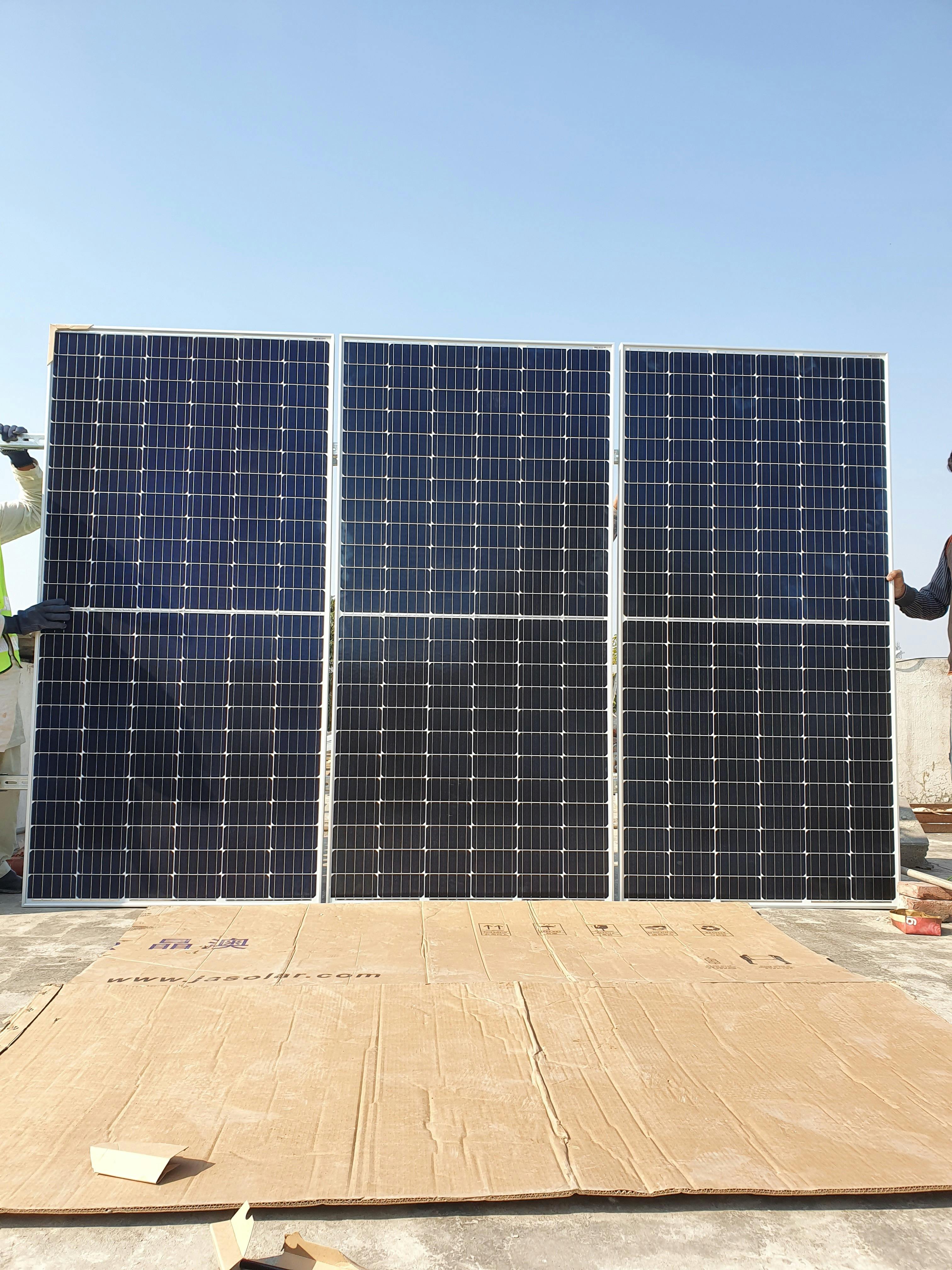
Should You Change the Solar Panel Angle Seasonally?
Short answer: Seasonal adjustment can theoretically improve solar capture because the sun’s position changes throughout the year, but most residential systems in Pakistan use a fixed mounting angle because regularly changing dozens of panels is inconvenient and adds structural complexity.
A seasonal mounting system can use a lower tilt during periods when the sun is higher and a steeper tilt when the winter sun is lower. Research on Pakistani cities confirms that optimum tilt varies substantially between seasons.
For most homeowners, however, a well-designed fixed angle is the practical choice.
Seasonal adjustment becomes more interesting when:
- The system is small enough to adjust manually.
- The mounting structure is specifically designed for adjustment.
- The owner is willing to make seasonal changes safely.
- Maximum production is more important than installation simplicity.
For a normal residential rooftop, spending more effort on shade avoidance, correct direction, structural quality and electrical design may provide more practical value than creating a complicated adjustable mounting system.
How to Check Panel Direction and Angle Before Installation
Before approving a solar installation, use this simple checklist.
- Identify the roof’s available directions. Determine which roof surfaces have the largest unobstructed area.
- Confirm true direction. Do not rely blindly on a basic magnetic compass reading.
- Check the local tilt reference. Use the city and exact site location as a starting point.
- Inspect shading. Check buildings, trees, walls, tanks and other structures.
- Check row spacing. On flat roofs, make sure one row will not cast significant shadows on another.
- Check roof structure. The mounting system must be appropriate for the roof and local wind conditions.
- Check inverter specifications. Panel orientation and tilt are only part of the complete PV design.
- Compare expected production. Ask the installer for a production estimate based on your actual location, orientation and tilt.
Tools such as the Solar Panel Calculator for Home Electricity Load and Solar Load Calculator can help with system-sizing questions, but they should not replace a professional site assessment for a final installation.
Common Solar Panel Direction and Angle Mistakes
1. Using the Same Angle for Every City
Karachi, Lahore, Islamabad and Peshawar do not have identical solar geometry. A single “Pakistan angle” can be useful as a rough starting point, but city and site conditions matter.
2. Confusing Latitude With the Exact Optimum Tilt
Latitude is an excellent rule of thumb, but solar-resource models can produce different optimum values because they account for local irradiation characteristics.
3. Installing Panels Completely Flat
A flat installation may be convenient, but it is not automatically the best configuration for annual energy production. On a flat roof, compare the benefits of a tilted structure against shading, wind and structural considerations.
4. Ignoring Shading
A theoretically perfect angle cannot make up for avoidable shading from tanks, walls, trees or adjacent structures.
5. Assuming East or West Is Always Wrong
South is generally preferred for annual production, but an east- or west-facing installation may still be sensible when roof geometry or the household’s consumption pattern makes it advantageous.
6. Optimizing Only the Panel Angle
Solar production also depends on solar irradiation, shading, temperature, dust, panel characteristics, inverter efficiency, wiring and other system losses. Orientation is important, but it is not the only design variable.

Does Panel Direction Affect a 5kW or 10kW System?
Yes. A 5kW or 10kW label describes the nominal capacity of the solar array or inverter, not a guarantee that the system will continuously generate that amount of electricity.
Actual PV production changes with:
- Solar irradiation
- Panel direction
- Panel tilt
- Shading
- Temperature
- Dust and soiling
- Panel technology and condition
- Inverter efficiency
- Wiring and other system losses
- Weather and season
This is particularly important when comparing expected production from different rooftops. Two identical 5kW systems can produce different amounts of electricity if one has better orientation and less shading.
For a 5kW system, correct orientation can therefore be considered part of the system design rather than an installation detail that can be ignored after the equipment has been selected.
For example, when evaluating a complete system, it is useful to combine the expected production with your actual household load. Our 5kW solar inverter guide explains why inverter capacity and appliance load are separate from solar-array capacity.
If you are considering a 5kW system, you can also read our guide on 5kW solar system electricity bill savings to understand why actual daytime consumption, generation and orientation all affect the financial result.
Frequently Asked Questions
What is the best direction for solar panels in Pakistan?
South is generally the best direction for a fixed solar array when the goal is to maximize annual energy production. More precisely, the preferred orientation is toward true south, approximately 180° azimuth.
What is the best solar panel angle in Pakistan?
For a broad Pakistan-wide annual reference, approximately 26°–32° is a useful range, with the optimum generally increasing toward northern areas. The exact angle should be selected according to the installation location and roof conditions.
What is the best solar panel angle for Lahore?
A fixed annual tilt around 30°–32° is a practical starting point for Lahore. A 2025 simulation study calculated an annual optimized tilt of approximately 30.25° for Lahore.
What is the best solar panel angle for Karachi?
Karachi generally needs a lower tilt than northern Pakistani cities. A 2025 simulation study calculated an annual optimized tilt of approximately 25.5°.
What is the best solar panel angle for Islamabad?
Islamabad’s annual optimum is higher than Karachi’s because of its more northerly location. A 2025 study calculated approximately 33.3° as an annual optimized tilt reference.
Should solar panels face exactly 180 degrees?
True south, approximately 180° azimuth, is the preferred reference for maximizing annual production from a fixed array. However, a small deviation from south does not automatically make a roof unsuitable. Shading, roof area and actual energy-use patterns should also be considered.
Can solar panels face west in Pakistan?
Yes. West-facing panels can still produce substantial electricity and may provide more afternoon-oriented generation. They are generally not the first choice when maximizing annual production is the only objective, but roof constraints and daytime consumption can make west or southwest orientations practical.
Is a 30-degree solar panel angle good for Pakistan?
Yes, 30° is a reasonable fixed angle for many locations in Pakistan, particularly in central Punjab and nearby areas. It should not be treated as the exact optimum for every city, because Karachi and some northern locations can have different optimum values.
Is a flat solar panel installation better?
Not necessarily. A flat panel can receive sunlight, but a suitable tilt can improve annual solar exposure. On flat roofs, the final decision should also consider row spacing, shading, wind loading and the amount of roof space available.
Does solar panel angle affect electricity generation?
Yes. Tilt and orientation affect how much solar radiation reaches the panel surface. However, the size of the effect depends on the actual location, orientation, shading and other system conditions. Angle should therefore be optimized as part of the complete PV design.
Should I change the solar panel angle in summer and winter?
Changing the tilt seasonally can theoretically improve solar capture because the sun’s position changes. For most residential installations, however, a correctly selected fixed angle is simpler and more practical than manually adjusting the structure several times each year.
Does the same solar panel angle work for 5kW and 10kW systems?
The required tilt is primarily determined by the installation location and design objective, not simply by whether the system is 5kW or 10kW. A 5kW and 10kW system at the same site can generally use the same optimum orientation and tilt, while their roof-space and row-spacing requirements may differ.
Final Takeaway
The most important answer is simple: for most fixed solar installations in Pakistan, face the panels toward true south and use a tilt appropriate for your location.
For a national planning reference, the World Bank’s Pakistan solar-resource assessment indicates an optimum annual tilt of roughly 26°–32°, increasing from south to north. City-specific research shows that individual locations can fall slightly outside that range, which is why an exact site assessment is preferable when designing a large or high-value installation.
For homeowners, do not focus only on achieving a mathematically perfect angle. A slightly different tilt on a completely shade-free roof can be better than a theoretically perfect angle surrounded by water tanks, walls or trees.
The best installation balances direction + tilt + shade-free area + roof structure + row spacing + electrical design + actual electricity usage.
If you are sizing the rest of the system, use your actual household load rather than selecting panels based only on roof size. Our solar panel calculator and solar load calculator can help with the planning stage.
Sources and Further Reading
- World Bank / ESMAP Solar Resource and Photovoltaic Power Potential of Pakistan
- U.S. Department of Energy — Solar Photovoltaic System Design Basics
- Global Solar Atlas — Optimum Tilt and Azimuth Methodology
- European Commission — Photovoltaic Geographical Information System (PVGIS)
- Energy Science & Engineering — Effect of Optimized Tilt Angle of PV Modules in Different Cities of Pakistan
Waseem Abbas is the Founder and Solar Research Editor at Solar Pakistan Guide, where he researches Pakistan’s solar energy market and publishes practical guides on solar panels, inverters, batteries, net metering, and solar system costs. His goal is to provide accurate, regularly updated, and easy-to-understand information that helps homeowners and businesses make informed solar energy decisions.
Areas of Expertise: Solar Panels • Solar Inverters • Batteries • Net Metering • Solar System Costs • Renewable Energy