
Can a 5kW Solar System Run 1.5 Ton AC? Yes, in most properly designed residential setups, a 5kW solar system can comfortably run a 1.5-ton inverter AC during good sunlight. The important point is that the AC is only one part of your household load. Inverter capacity, actual AC power consumption, solar production, weather, and other appliances all determine how comfortably the system will operate.
For a typical home in Pakistan, a 5kW system is generally a practical size for running one 1.5-ton inverter AC during the daytime while also powering moderate household loads such as fans, lights, a refrigerator, TV, and internet equipment.
However, a 5kW solar system does not automatically mean that every 1.5-ton AC will consume the same amount of electricity. AC models differ considerably, so the rating plate or manufacturer datasheet should always be checked before final system sizing.
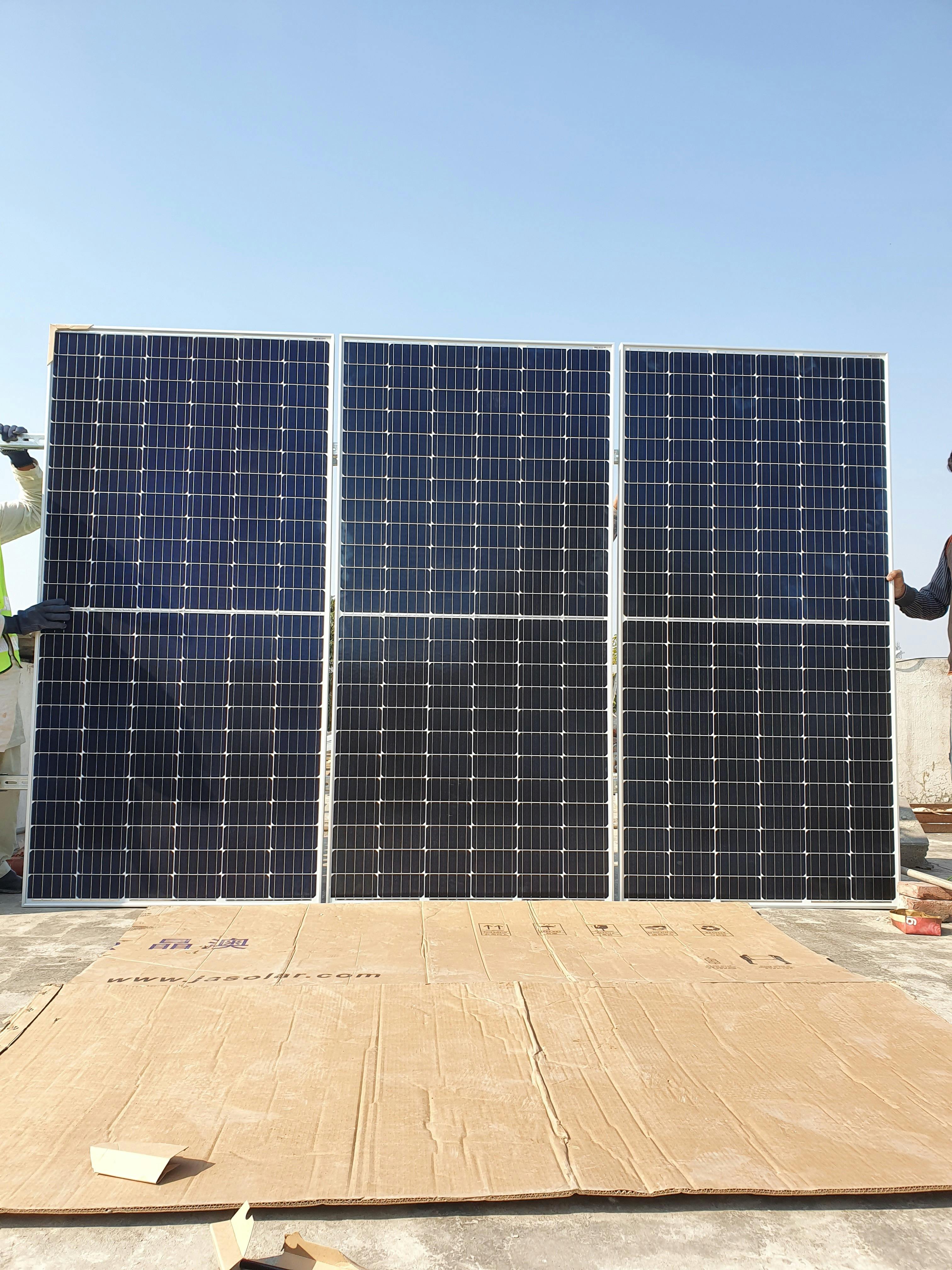
Can a 5kW Solar System Run 1.5 Ton AC?
Short answer: Yes. A properly designed 5kW solar system can run one 1.5-ton inverter AC, particularly during daylight hours when the solar panels are producing power. A typical 1.5-ton inverter AC can use considerably less than 5kW, leaving part of the inverter capacity for other appliances. Actual performance depends on the AC model, solar production, inverter rating, and simultaneous household load.
The key is to understand the difference between solar panel capacity, inverter capacity, and actual appliance consumption.
- A 5kW solar array refers to the rated capacity of the solar panels.
- A 5kW inverter refers to how much AC power the inverter can supply, subject to its specifications.
- A 1.5-ton AC does not necessarily consume 1.5kW continuously.
- An inverter AC can reduce compressor speed after the room reaches the desired temperature.
- Your other appliances must be included when calculating the total load.
This distinction is important because a 5kW system can run a 1.5-ton AC very differently depending on whether you are running only the AC or the AC plus refrigerator, water pump, fans, lights and other appliances.
How Much Power Does a 1.5 Ton AC Use?
A 1.5-ton AC describes its cooling capacity, not its exact electrical consumption.
For example, a current Panasonic 1.5-ton inverter AC specification lists a standard cooling input of 1,270W, with a stated input range of 403W to 1,715W depending on operating conditions. Another 1.5-ton model from the same manufacturer lists a standard input of 1,690W and a maximum of 2,282W. This demonstrates why using a single fixed wattage for every 1.5-ton AC can produce an inaccurate solar calculation.
In practical terms, an inverter AC may draw more power while the room is being cooled and considerably less after the desired temperature has been reached. The exact power depends on the model, outdoor temperature, thermostat setting, room insulation, sunlight entering the room, and other conditions.
| Factor | Effect on AC Power Use |
|---|---|
| AC model | Different models have different rated and maximum input power. |
| Inverter technology | Compressor speed can vary instead of continuously operating at full power. |
| Outdoor temperature | Very hot weather can increase cooling demand. |
| Room insulation | Poor insulation can make the AC work harder. |
| Thermostat setting | Lower temperature settings can increase energy consumption. |
| Sun exposure | A heavily sun-exposed room can require more cooling. |
For your own system, the best number to use is the input power shown on your AC’s nameplate or official datasheet, rather than a generic internet estimate.
5kW Solar System and 1.5 Ton AC Load Calculation
A simple example makes the answer much clearer.
Suppose your 1.5-ton inverter AC is drawing approximately 1.3kW at a particular operating point. You also have:
| Appliance | Example Load |
|---|---|
| 1.5-ton inverter AC | 1.3kW |
| Refrigerator | 0.15–0.30kW while compressor is operating |
| 4 fans | Approximately 0.20–0.35kW total, depending on fan type |
| LED lights | Approximately 0.05–0.15kW |
| TV + router + small electronics | Approximately 0.10–0.20kW |
| Illustrative total | About 1.8–2.3kW |
This illustrative load is comfortably below a 5kW inverter’s nominal output. But these numbers are examples, not a universal specification. Your actual appliance labels should be used before purchasing equipment.
If you add a high-power water pump, iron, microwave, electric kettle or another AC at the same time, the load can increase quickly.
For a more accurate calculation, use the Solar Load Calculator on Solar Pakistan Guide and enter the actual wattage of your appliances.
What Inverter Size Is Needed for a 1.5 Ton AC?
Short answer: A 5kW inverter is generally a comfortable size for one 1.5-ton inverter AC plus moderate household loads, provided the inverter’s continuous output, surge capability, AC input limits and solar MPPT specifications are suitable. The exact requirement should be calculated from the AC’s nameplate power and the other appliances that may operate simultaneously.
Do not choose an inverter solely because the solar panels are rated at 5kW.
For example, if your household can occasionally reach 3.5kW of simultaneous demand, selecting an inverter with insufficient headroom can cause overload warnings or shutdowns. Motors and compressors can also create temporary startup demands.
Your inverter should therefore have enough capacity for:
- Normal AC running power
- Other appliances operating at the same time
- Temporary startup or surge requirements where applicable
- A sensible operating margin
Solar Pakistan Guide’s Inverter Sizing Calculator can be used to estimate inverter capacity using running load and surge requirements.
Can a 5kW Solar System Run a 1.5 Ton AC During the Day?
Yes, daytime operation is where a 5kW system makes the most sense for this load.
When sunlight is strong, the solar panels can directly supply the AC and other household appliances through the inverter. You do not need to think of the entire 5kW rating as being consumed by the AC.
For example, if the AC is using around 1.3kW and the home is using another 700W, the combined load is roughly 2kW. If the solar array is producing more than that at that moment, the remaining available generation can supply additional loads, charge a battery in a hybrid system, or interact with the grid according to the system configuration.
But solar production changes throughout the day. Early morning, late afternoon, cloudy weather, dust and high panel temperature can reduce instantaneous output.
Important: A 5kW solar system is rated under specified test conditions. It should not be assumed that the panels will continuously deliver exactly 5kW from sunrise to sunset.
Can a 5kW Solar System Run a 1.5 Ton AC at Night?
Not from solar panels alone.
Solar panels do not produce useful electricity from sunlight after sunset. If you want to operate the AC at night, you need another electricity source.
Depending on your setup, that can be:
- Grid electricity: The AC switches to grid supply when solar is unavailable.
- Battery storage: A hybrid inverter can use stored energy to run the AC.
- Generator: A generator can provide backup power where appropriate.
A battery changes the economics and sizing considerably because an AC consumes substantially more energy than small loads such as LED lights or a router.
If you are considering battery backup, first calculate how many hours you actually want the AC to operate. Then calculate the required usable battery energy rather than choosing a battery only because it is marketed as a “5kW solar battery.”
You can use the Battery Backup Time Calculator to estimate runtime from your battery size and load.
Can You Run Other Appliances With the AC?
Yes, and this is one of the biggest advantages of a 5kW system compared with a smaller solar setup.
If your 1.5-ton inverter AC is consuming around 1–2kW at a particular moment, a properly sized 5kW inverter can potentially supply additional household loads at the same time.
| Load Combination | 5kW System Suitability |
|---|---|
| 1.5-ton inverter AC only | Generally suitable |
| AC + fans + lights | Generally suitable |
| AC + fans + lights + refrigerator | Generally suitable with appropriate sizing |
| AC + refrigerator + water pump + normal loads | Check total running and surge load |
| AC + another AC + heavy appliances | Requires detailed load calculation |
The last two cases need more attention because a water pump, refrigerator compressor or additional AC can create a higher temporary demand.
How Many Solar Panels Are Needed for a 1.5 Ton AC?
The answer depends on whether you are sizing the panels for the AC alone or designing a complete 5kW household solar system.
If your target is a 5kW array, the number of panels depends on panel wattage:
| Panel Rating | Approximate Panels for 5kW Array | Nominal Array Size |
|---|---|---|
| 550W | 10 panels | 5.50kW |
| 575W | 9 panels | 5.175kW |
| 580W | 9 panels | 5.22kW |
| 585W | 9 panels | 5.265kW |
| 600W | 9 panels | 5.40kW |
These are simple arithmetic examples. The final panel arrangement must also satisfy the inverter’s MPPT voltage range, maximum PV voltage, maximum PV current and permitted PV array size.
For a 5kW residential installation, panel count should therefore be selected together with the inverter rather than independently.
On-Grid vs Hybrid: Which Is Better for a 1.5 Ton AC?
The right choice depends mainly on when you want the AC to operate and whether backup power is important.
| Feature | On-Grid | Hybrid |
|---|---|---|
| Daytime AC operation | Yes | Yes |
| Night-time AC during grid outage | No | Yes, if battery is sized adequately |
| Battery required | No | Usually yes for backup |
| Backup during grid outage | Normally unavailable | Available when properly configured |
| System complexity | Lower | Higher |
| Best use case | Maximum daytime solar usage | Daytime solar + backup |
For a household where the main objective is to operate a 1.5-ton AC during sunny daytime hours, an on-grid system can be attractive. If you also want the AC available during load-shedding or at night, a hybrid inverter with appropriately sized battery storage becomes more relevant.
Pakistan’s regulatory environment has also changed. NEPRA’s legal database now lists the National Electric Power Regulatory Authority (Prosumer) Regulations, 2026 and subsequent amendments, so anyone designing a new system should verify the current rules rather than relying on older net-metering articles.
What Happens During Pakistan’s Summer?
Pakistan’s hot summer weather makes AC sizing more important than simply looking at the nominal 5kW solar rating.
When outdoor temperatures rise, the AC can need more cooling power. At the same time, solar panels operate under real-world conditions rather than laboratory test conditions.
This means you should avoid designing a system around the assumption that:
5kW panels = 5kW continuous output + unlimited AC capacity.
A better approach is to maintain reasonable headroom between your expected household load and inverter capacity.
Room conditions also matter. ENERGY STAR recommends properly sizing cooling equipment for the space being cooled, while efficiency and installation quality can affect actual energy use. An oversized or poorly installed cooling system may not deliver the expected efficiency.
For a Pakistani home, practical factors include:
- Room size
- Roof and wall insulation
- Direct sunlight through windows
- AC efficiency
- Outdoor temperature
- AC temperature setting
- Number of people in the room
- Solar panel orientation and shading
- Panel cleanliness
- Other appliances running simultaneously
Common Mistakes When Designing Solar for a 1.5 Ton AC
1. Assuming Every 1.5 Ton AC Uses the Same Power
This is one of the most common mistakes. Two 1.5-ton ACs can have different rated input powers and operating ranges.
2. Looking Only at the Panel Capacity
A 5kW panel array does not tell you whether the inverter is correctly sized. The inverter’s output rating and PV input specifications are equally important.
3. Ignoring Other Appliances
If the AC is using 1.5kW, that does not mean the remaining 3.5kW of a 5kW inverter is automatically available without considering pumps, refrigerators, fans and other loads.
4. Forgetting Battery Requirements
A solar panel system cannot provide nighttime solar generation. If you want AC backup after sunset, battery capacity must be calculated separately.
5. Choosing a Battery Only by kW
Inverter power is normally expressed in kW, while battery storage is commonly discussed in kWh or Ah. A 5kW inverter and a 5kWh battery are not the same thing.
6. Using Generic AC Wattage
The safest approach is to read the AC’s electrical specification and use its rated and maximum input values for system planning.
Calculate Your Exact Solar Load
If you already own a 1.5-ton AC, do not guess the complete system size.
Start with the actual wattage of:
- AC
- Refrigerator
- Fans
- Lights
- TV
- Water pump
- Washing machine
- Computer equipment
- Any other appliance you expect to operate at the same time
Then calculate both the running load and the possible startup/surge load.
For a quick estimate, use the Solar Load Calculator. If the main question is inverter capacity, use the Inverter Sizing Calculator.
For comparison, a 3kW system can be suitable for lighter household loads, but your own Solar Pakistan Guide guide notes that a 1.5-ton AC generally calls for more system headroom. You can compare the smaller setup with the 3kW Solar System guide.
Frequently Asked Questions
Can a 5kW solar system run a 1.5 ton inverter AC?
Yes. A properly designed 5kW solar system can normally run one 1.5-ton inverter AC during daylight hours, provided the inverter and total household load are correctly sized. The AC’s actual electrical consumption varies by model and operating conditions.
How many watts does a 1.5 ton AC consume?
There is no single wattage for every 1.5-ton AC. For example, one current Panasonic 1.5-ton inverter model lists 1,270W standard cooling input and a 403–1,715W operating range. Other models can have different specifications, so check the manufacturer’s datasheet.
Can a 5kW solar system run AC and refrigerator together?
Yes, in many residential installations. A 1.5-ton inverter AC plus a refrigerator and normal household loads can fit comfortably within a properly sized 5kW system, but the exact result depends on the appliances’ actual running and surge requirements.
Can a 5kW solar system run a 1.5 ton AC at night?
Not from solar panels alone. At night, you need grid electricity, a suitably sized battery through a hybrid inverter, or another backup source. Battery capacity should be calculated according to how long you want the AC to operate.
Is a 5kW inverter enough for a 1.5 ton AC?
Usually, yes, when the 1.5-ton AC is combined with normal household loads and the inverter has adequate continuous and surge capacity. However, the final selection should be based on the AC’s nameplate power, other simultaneous loads and the inverter manufacturer’s specifications.
How many 585W solar panels are needed for a 5kW system?
Nine 585W panels produce a nominal 5.265kW array. The actual panel arrangement must still be checked against the solar inverter’s maximum PV voltage, current, MPPT range and permitted PV capacity.
Can a 5kW solar system run a non-inverter 1.5 ton AC?
It may be able to, but a non-inverter AC can behave differently from an inverter AC and may have a larger starting demand. The inverter’s surge capability and the AC’s electrical specifications should therefore be checked before installation.
Is 5kW solar enough for one AC in Pakistan?
For one 1.5-ton inverter AC, 5kW is generally a practical residential size, especially when the AC operates during daylight and the rest of the household load is moderate. Very heavy simultaneous loads may require a larger inverter or different system design.
Should I choose on-grid or hybrid for a 1.5 ton AC?
Choose based on your usage. On-grid is suitable when your priority is daytime solar consumption and grid support. Hybrid is more suitable when you also want battery backup during outages or want to shift solar energy into evening use.
Final Verdict
Yes, a 5kW solar system can run a 1.5-ton AC, and for many homes in Pakistan it is a sensible combination.
The important point is not simply the “1.5 ton” label. The actual AC input power, inverter capacity, other household appliances, solar production and battery requirements determine how well the system performs.
For a daytime-focused home, a properly configured 5kW system can provide enough capacity for one 1.5-ton inverter AC plus moderate household loads. If you want the AC to continue running during nighttime or load-shedding, the system needs appropriately sized battery storage and a compatible hybrid inverter.
Before buying equipment, check the AC’s actual nameplate power, calculate your simultaneous household load, and confirm the inverter’s continuous output, surge capability and PV input limits. That approach is much more reliable than choosing a system simply because a dealer says “5kW is enough.”
Bottom line: For one 1.5-ton inverter AC, a well-designed 5kW solar system is generally a strong starting point for a Pakistani home, but the final system should be sized around your real appliance load rather than the AC tonnage alone.

Waseem Abbas is the Founder and Solar Research Editor at Solar Pakistan Guide, where he researches Pakistan’s solar energy market and publishes practical guides on solar panels, inverters, batteries, net metering, and solar system costs. His goal is to provide accurate, regularly updated, and easy-to-understand information that helps homeowners and businesses make informed solar energy decisions.
Areas of Expertise: Solar Panels • Solar Inverters • Batteries • Net Metering • Solar System Costs • Renewable Energy